
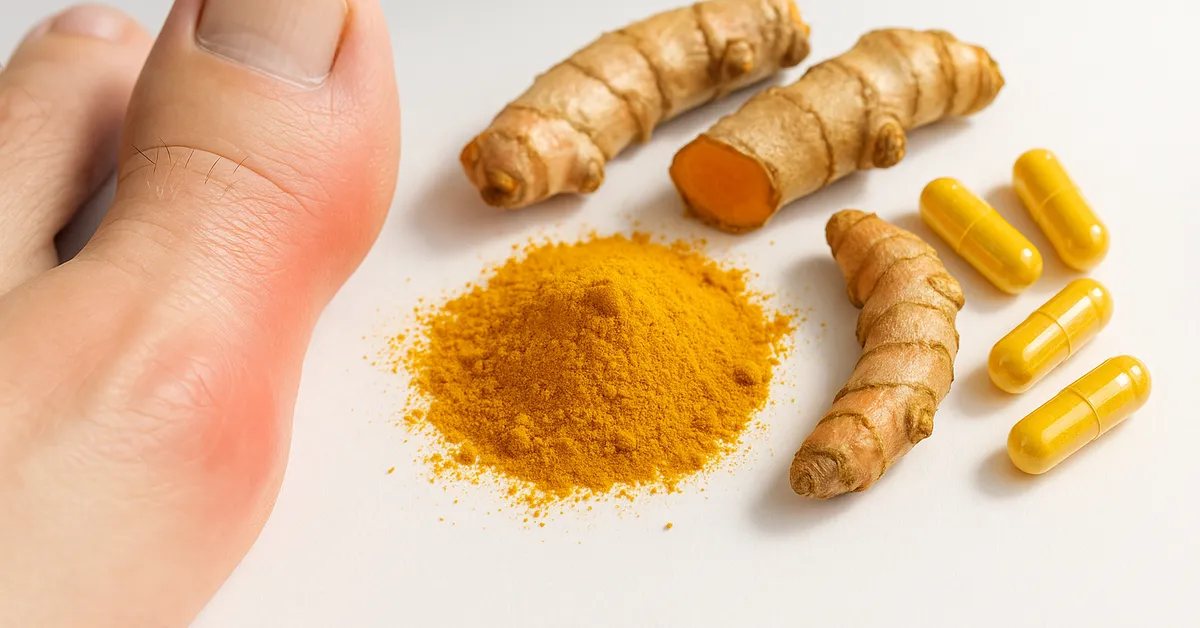
Gout is one of the most intensely painful forms of arthritis, and its triggers are well understood: uric acid accumulates in the blood, crystallizes in joint spaces, and the immune system attacks the crystals, producing severe inflammation. Treatment focuses on two targets, reducing the acute inflammatory response during flares and lowering uric acid levels long-term to prevent future attacks. Curcumin, turmeric’s active polyphenol, has shown activity against both mechanisms in research settings.
Disclosure: This post contains affiliate links. We may earn a commission if you purchase through our links, at no extra cost to you. We only recommend products we trust.
Here’s what the science shows about turmeric for gout, where the evidence is strong, where it’s more preliminary, and what a practical protocol looks like.
How Gout Inflammation Works
Understanding why curcumin is relevant to gout starts with how gout flares actually develop. When monosodium urate (MSU) crystals deposit in a joint, typically the big toe, ankle, or knee, resident macrophages recognize them as foreign material and trigger the NLRP3 inflammasome. This activates a cascade that produces large amounts of IL-1 beta, one of the most potent pro-inflammatory cytokines in the human body. The result is the rapid, severe inflammation characteristic of gout: intense pain, redness, swelling, and heat that develops over hours and peaks within 24 to 48 hours.
Standard gout treatments target this pathway directly. Colchicine inhibits microtubule formation and reduces neutrophil recruitment. NSAIDs suppress COX enzymes. Corticosteroids broadly suppress immune activation. Curcumin operates through overlapping mechanisms: it inhibits NF-kB signaling (which drives NLRP3 and IL-1 beta production), reduces prostaglandin synthesis through COX-2 inhibition, and has shown direct effects on the NLRP3 inflammasome pathway in preclinical studies.
What Research Shows About Curcumin and Uric Acid
The more interesting finding is curcumin’s potential effect on uric acid production, not just inflammation. Uric acid is the end product of purine metabolism, catalyzed by an enzyme called xanthine oxidase (XO). Allopurinol, the most common long-term gout medication, works by inhibiting XO directly.
A comprehensive 2023 review examined the anti-gout and urate-lowering potential of curcumin, finding that curcumin demonstrates xanthine oxidase inhibitory properties, urate transporter-1 (URAT1) inhibitory characteristics, and antioxidant and anti-inflammatory effects relevant to gout pathology (PMID: 37488765).
A 2020 randomized placebo-controlled trial directly tested curcumin’s effect on serum urate levels in adults with asymptomatic hyperuricemia (elevated uric acid without active gout). The study confirmed that curcumin inhibits xanthine oxidase and increases uricosuric activity, with the treated group showing statistically significant reductions in serum uric acid compared to placebo (PMID: 32420786).
A 2025 mechanistic study added further detail, finding that high-dose curcumin notably inhibits XOD (xanthine oxidase) activity while also enhancing renal ABCG2 transporter expression, which promotes uric acid excretion. The combination of reduced production and increased elimination is a dual mechanism that no existing gout medication fully captures (PMID: 41035515).
Curcumin’s Anti-Inflammatory Effects During Gout Flares
During an active gout attack, the priority is controlling inflammation rapidly. This is where conventional medications have a clear advantage in speed: colchicine and NSAIDs can reduce flare severity within 24 to 48 hours. Curcumin’s onset is slower, particularly at standard supplement doses.
That said, the evidence for curcumin’s effects on IL-1 beta and NLRP3 inflammasome activation suggests it can meaningfully reduce flare severity when used consistently. Some practitioners recommend higher curcumin doses (1,500 to 2,000 mg curcuminoids daily with BioPerine) during active flares alongside standard treatment. The anti-inflammatory mechanisms are complementary to, not competitive with, NSAIDs or colchicine.
For background on curcumin’s general pain and inflammation mechanisms, see our articles on turmeric for pain and the research behind turmeric for joint inflammation.
Long-Term Gout Management with Curcumin
The more promising application for curcumin in gout is long-term prevention rather than acute flare management. Regular curcumin supplementation that maintains modest xanthine oxidase inhibition and reduces chronic inflammatory baseline could, in theory, reduce both flare frequency and uric acid levels over time.
People with hyperuricemia who want to reduce uric acid before it reaches the threshold for drug therapy, or those who can’t tolerate allopurinol, represent a population where curcumin’s dual mechanism is particularly relevant.
There’s also a systemic inflammation angle: gout patients typically have elevated CRP and other inflammatory markers even between flares. Curcumin’s anti-inflammatory effects on NF-kB signaling may help reduce this background inflammatory state, which itself drives uric acid crystal deposition and flare frequency.
Dosage and Formulation for Gout
The uric acid lowering trials used curcumin in amounts ranging from 500 mg to approximately 1,000 mg of curcuminoids daily. Anti-inflammatory effects in joint pain trials have used 500 to 1,500 mg daily. A reasonable protocol for gout management sits at 1,000 to 1,500 mg curcuminoids per day with a bioavailability enhancer.
Piperine (BioPerine) is essential. Plain curcumin absorbs poorly, and the XO-inhibitory effects observed in research depend on curcumin actually reaching relevant concentrations in circulation. A formulation with BioPerine delivers several times more curcumin to the bloodstream than unenhanced versions.
Take with meals, ideally ones containing some fat. Twice daily dosing maintains more consistent levels throughout the day compared to a single dose. Consistent use over 8 to 12 weeks is needed to assess uric acid effects, since the RCT showing urate reduction ran for 8 weeks.
The MFL health journal covers turmeric for gout in detail, including mechanisms and dosing context, and turmeric for chronic inflammation addresses the background inflammatory state relevant to gout.
Important Caveats
Curcumin is not a replacement for allopurinol or febuxostat in people with established gout requiring urate-lowering therapy. If your uric acid is significantly elevated and you’re having recurrent flares, that requires medical management. Curcumin works best as a complement to that treatment, or as an early intervention in people with borderline hyperuricemia.
The evidence that curcumin lowers uric acid is promising but limited to a small number of trials. The mechanistic evidence (XO inhibition, URAT1 inhibition, ABCG2 upregulation) is solid, but large-scale RCTs in clinical gout patients with hard endpoints are still limited.
There’s also a dietary note: the biggest lever for uric acid levels remains diet. Reducing purine-rich foods (organ meats, shellfish, red meat), limiting alcohol (especially beer), and staying well-hydrated have stronger evidence than any supplement for uric acid management.
What to Expect
If you’re using curcumin for gout management, here’s a realistic picture of the timeline. Within 2 to 4 weeks, some reduction in background inflammation may occur, which may reduce overall joint sensitivity. Within 8 weeks, if it’s working, uric acid levels should show at least modest reduction (this requires a blood test to verify). Flare frequency changes may take 3 to 6 months to be meaningfully assessable, since flare patterns are inherently variable.
Me First Living’s Turmeric Curcumin with Black Pepper provides 1,000 mg curcuminoids per serving with BioPerine, consistent with research dosing. Also available on Amazon if that’s more convenient.
Check your uric acid at baseline and after 8 weeks if you’re using curcumin for urate management. That data will tell you whether it’s working for your specific biochemistry, which varies between individuals.