
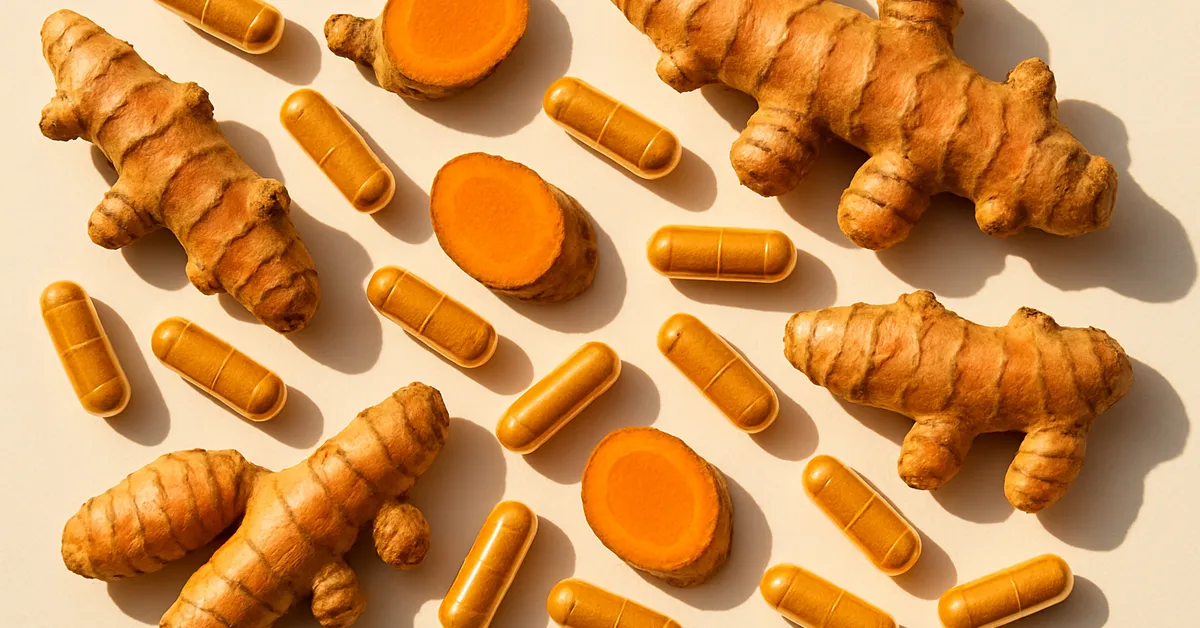
Turmeric has been used as a natural remedy for thousands of years, but does the science actually back it up when it comes to pain relief? If you’ve been dealing with chronic pain and wondering whether turmeric might help, you’re asking exactly the right question.
Disclosure: This post contains affiliate links. We may earn a commission if you purchase through our links, at no extra cost to you. We only recommend products we trust.
The short answer is yes – with some important caveats. Here’s what the research actually shows.
What Makes Turmeric Work for Pain?
The active compound in turmeric is called curcumin. It’s what gives turmeric its distinctive yellow-orange color, and it’s also the compound responsible for most of its medicinal effects.
Curcumin works as a natural anti-inflammatory by blocking NF-kB, a molecule that activates genes related to inflammation. In simpler terms: it turns down the volume on your body’s inflammatory response, which is often what’s causing pain in the first place.
Research published in the journal Oncogene found that curcumin is among the most potent natural anti-inflammatory compounds ever identified. It inhibits multiple inflammatory pathways simultaneously – something that most pharmaceutical anti-inflammatories can’t do.
What the Clinical Research Shows
Over 100 clinical trials have examined curcumin’s effects on pain and inflammation. Here are some of the most compelling findings:
Osteoarthritis Pain
A 2016 systematic review published in the Journal of Medicinal Food analyzed 8 randomized controlled trials on curcumin for joint pain. The conclusion? Curcumin supplementation was consistently effective at reducing pain and improving function in patients with osteoarthritis. For a deeper look at what to look for in a quality product, see this guide to the best turmeric supplement for joint pain.
One landmark study compared a curcumin supplement to ibuprofen in patients with knee osteoarthritis. Both groups reported similar reductions in pain – but the curcumin group experienced significantly fewer gastrointestinal side effects.
Post-Exercise Muscle Soreness
Athletes and active people have been paying attention to turmeric for good reason. A study published in the European Journal of Applied Physiology found that curcumin supplementation significantly reduced muscle damage and soreness after intense exercise.
Participants who took curcumin reported less pain 24 and 48 hours after a strenuous workout compared to the placebo group. Their blood markers of muscle damage were also notably lower.
Chronic Back Pain
A pilot study examining curcumin for chronic low back pain found meaningful reductions in pain scores after 12 weeks of supplementation. While more research is needed in this area, the results are promising.
The Bioavailability Problem (And How to Solve It)
Here’s the catch with turmeric: curcumin on its own is poorly absorbed by the body. You could eat a whole jar of turmeric powder and most of the curcumin would pass right through you without being absorbed into your bloodstream.
This is why so many people try turmeric and don’t notice any effect – they’re not taking it in a form that their body can actually use.
The solution? Look for these bioavailability enhancers:
- Black pepper (piperine): Studies show that piperine – the active compound in black pepper – increases curcumin absorption by up to 2,000%. Even a small amount makes a dramatic difference.
- Fat: Curcumin is fat-soluble, meaning it absorbs better when taken with a meal that contains fat. Taking your supplement with food (especially food containing healthy fats) significantly improves uptake.
- Liposomal or phospholipid-complexed curcumin: Some supplements use patented delivery systems like Meriva or Longvida that dramatically improve bioavailability compared to standard curcumin extracts.
How Much Turmeric Do You Need?
Most of the clinical research showing benefits used curcumin doses between 500mg and 2,000mg per day. Standard turmeric powder contains only about 2-3% curcumin by weight, so you’d need to consume enormous amounts of culinary turmeric to get therapeutic doses.
This is why supplements – standardized to contain 95% curcuminoids – are more practical for pain relief than just adding turmeric to your food.
That said, cooking with turmeric is still beneficial. Golden milk, turmeric tea, and adding turmeric to meals all contribute to your overall intake. Just don’t rely on cooking alone if you’re dealing with significant pain.
What Kinds of Pain Does Turmeric Help Most?
Based on the available evidence, turmeric tends to be most effective for:
- Inflammatory arthritis pain (osteoarthritis, rheumatoid arthritis)
- Post-exercise muscle soreness
- General inflammatory pain
- Digestive inflammation-related discomfort
The research is less robust for neuropathic pain (nerve pain), though some preliminary studies suggest curcumin may have neuroprotective properties.
Is Turmeric Safe?
Turmeric has an excellent safety profile. It’s been consumed as a spice and medicine for thousands of years, and clinical trials using therapeutic doses have generally found it to be well-tolerated.
Some considerations:
- Blood thinners: Curcumin has mild blood-thinning properties. If you’re on anticoagulants like warfarin, talk to your doctor before supplementing.
- Gallstones: Turmeric stimulates bile production, which can be problematic for people with gallstones or bile duct issues.
- High doses: Very high doses (above 8g per day) may cause digestive discomfort in some people. Stick to recommended doses.
The Bottom Line
The science is clear: turmeric works for pain. It’s not magic, it’s not a replacement for medical treatment, and it won’t work overnight – but for many people dealing with inflammatory pain, it’s a meaningful, evidence-backed tool.
The key is taking the right form, at the right dose, with proper bioavailability enhancers. Do that consistently for 4-8 weeks, and most people start to notice real differences.
If you’re looking for where to start, check out our guide to the best turmeric supplements or also on Amazon – we’ve done the research on what actually works and what’s just marketing fluff.